HomeHire Your First Employee › Get new hire paperwork done right

Get new hire paperwork done right

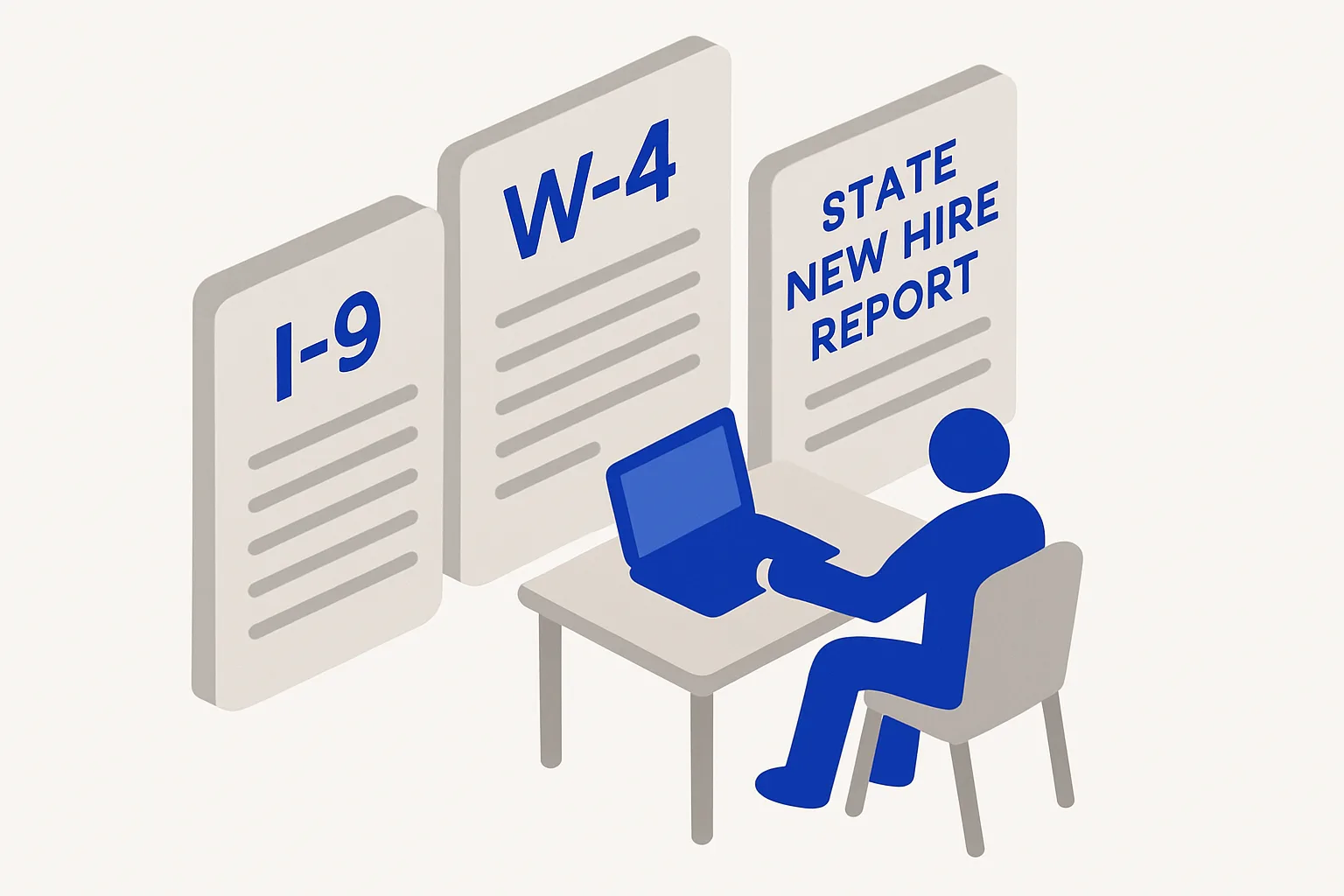
Form I-9, Form W-4, and the state new hire report are mandatory for your first employee. Here is what to collect, the deadlines that apply, and how to store it all.

Updated Jul 31, 2026 ·
Get new hire paperwork done right

Why this matters

Three pieces of paperwork are legally mandatory for every US hire: the I-9, the W-4, and the state new-hire report. Each has a hard deadline measured in days and penalties for being missing or late. This is pure compliance — no judgment calls.

What "done" looks like

  • I-9 Section 1 completed by the employee on or before the first day
  • I-9 Section 2 completed by you within three business days of the start
  • W-4 (plus state withholding form) collected before the first payroll
  • State new-hire report filed within your state's deadline

How to do it

  1. Have the employee complete I-9 Section 1 by day one — it can be done any time after the offer is accepted.
  2. Examine documents and complete Section 2 within three business days. The employee chooses what to present from the I-9's Lists of Acceptable Documents; you cannot demand specific ones.
  3. Collect the W-4 and your state's withholding certificate before running the first payroll.
  4. File the new-hire report — federal law caps the deadline at 20 days, and many states require it sooner. Most payroll software files it automatically; confirm yours does.
  5. Store and retain correctly: keep I-9s separate from personnel files, for three years after hire or one year after separation, whichever is later.

Common mistakes

  • Dictating which ID documents you'll accept — that is itself a violation.
  • Letting a new hire work for weeks with no I-9 on file.
  • Forgetting the state new-hire report — the least-known of the three, and still mandatory.

Real-world examples

  • USCIS sets the I-9 deadlines, and ICE audits fine employers per missing or defective form — even when every hire was legally authorized to work.
  • The 20-day federal ceiling on new-hire reporting comes from the 1996 welfare-reform law; states run the directories and many set shorter windows.

From a founder's point of view

Hiring paperwork is the rare part of running a business where the rules are completely spelled out. Treat it like a preflight checklist: same three forms, same deadlines, every hire.

Rule of thumb

By the end of the new hire's third day you should have a complete I-9, a signed W-4, and the new-hire report filed or queued.

Our guides are researched and reviewed from multiple angles, including AI tools, primary sources, and experienced founders. They are general information, not professional advice. Please verify important details yourself or with a qualified professional.

Stop reading. Start checking it off.

"Get new hire paperwork done right" is a live step inside FoundersCheckList.AI, seeded into your checklist, tracked, and pushed forward by an AI coach that reads your real progress.

Don't just read it, check it off.

This step lives inside a working checklist, with an AI coach pushing you through it.

Start for free →
Free plan available · No credit card required
Keep exploring

Related across the site

NewsAEWV minimum pay rises to NZD $23.95/hr from 1 April 2026Any founder hiring a migrant through the AEWV scheme must ensure offer letters and job ads meet the $23.95/hr floor from 1 April 2026 or risk visa refusal. Budget wage costs against the new rate before advertising, and note the reduced 2-year work-experience requirement makes overseas hires easier than in prior years.NewsCourt strikes down $100,000 H-1B fee; First Circuit lets ruling stand (July 2026)If you were holding off on sponsoring an H-1B hire because of the $100K sticker shock, that barrier is lifted for now — petitions previously stalled by the fee can move forward. But this is mid-appeal and could reverse, so if you have a strong overseas candidate, moving sooner reduces your exposure to a fee that may snap back if the government wins.NewsDOL proposes narrower joint-employer liability ruleIf you use a staffing agency, run a franchise, or rely heavily on subcontractors, joint-employer status determines whether you can be held liable for another company's wage-and-hour violations. A narrower test generally reduces your exposure, but the rule is only proposed — watch for the final version before assuming it applies. Review your staffing and franchise contracts now so you know where liability sits today.ToolDocuSignDocuSign lets you send documents for legally binding electronic signature and track their status. It handles contracts, NDAs, offer letters, and other agreements with an audit trail.TermDilutionThe reduction in your ownership percentage that happens when a company issues new shares, typically to raise money or grant options.TermEIN (Employer Identification Number)A unique nine-digit number the US IRS assigns to your business for tax and identification purposes, like a Social Security number for your company.