Startup terms, in plain English.
25 founder terms defined clearly, each with a "how it helps you" angle. No jargon for jargon's sake.

An independent appraisal of a private company's common stock, used to set the strike price for employee stock options in the US.

Building a company using your own money and the revenue it generates, rather than raising outside investment.

The rate at which your company spends cash each month, showing how quickly you're depleting your bank balance.

The average total sales and marketing cost to acquire one new paying customer.
A record of who owns what in your company: every shareholder, their share count, class, and ownership percentage.
The percentage of customers or revenue you lose over a period, the leak in your growth bucket.

A short-term loan to a startup that converts into equity at a later priced round instead of being repaid in cash.
The reduction in your ownership percentage that happens when a company issues new shares, typically to raise money or grant options.

A unique nine-digit number the US IRS assigns to your business for tax and identification purposes, like a Social Security number for your company.

A reserved block of company shares set aside to grant as stock options to employees, aligning their upside with the company's success.

The staged journey prospects take from first awareness to paying customer, with people dropping off at each step.
Your plan for how you'll reach, sell to, and win customers, the bridge from product to revenue.
The percentage of revenue left after the direct costs of delivering your product or service, a core measure of business quality.
The two most common US business structures: an LLC offers pass-through tax and flexibility; a C-corp is standard for raising venture capital.
The total gross profit you expect to earn from a customer over the entire time they stay with you.
Monthly and annual recurring revenue: the predictable subscription income a business earns each month or year.

The simplest version of your product that delivers core value and lets you test key assumptions with real users.
A deliberate change in strategy, product, market, or model, made to find a better path while keeping what you've learned.
The point where you've built something a specific market genuinely wants, shown by strong demand, retention, and organic pull.
How many months your company can keep operating before it runs out of cash, at its current spending rate.
Every term, right where you need it.
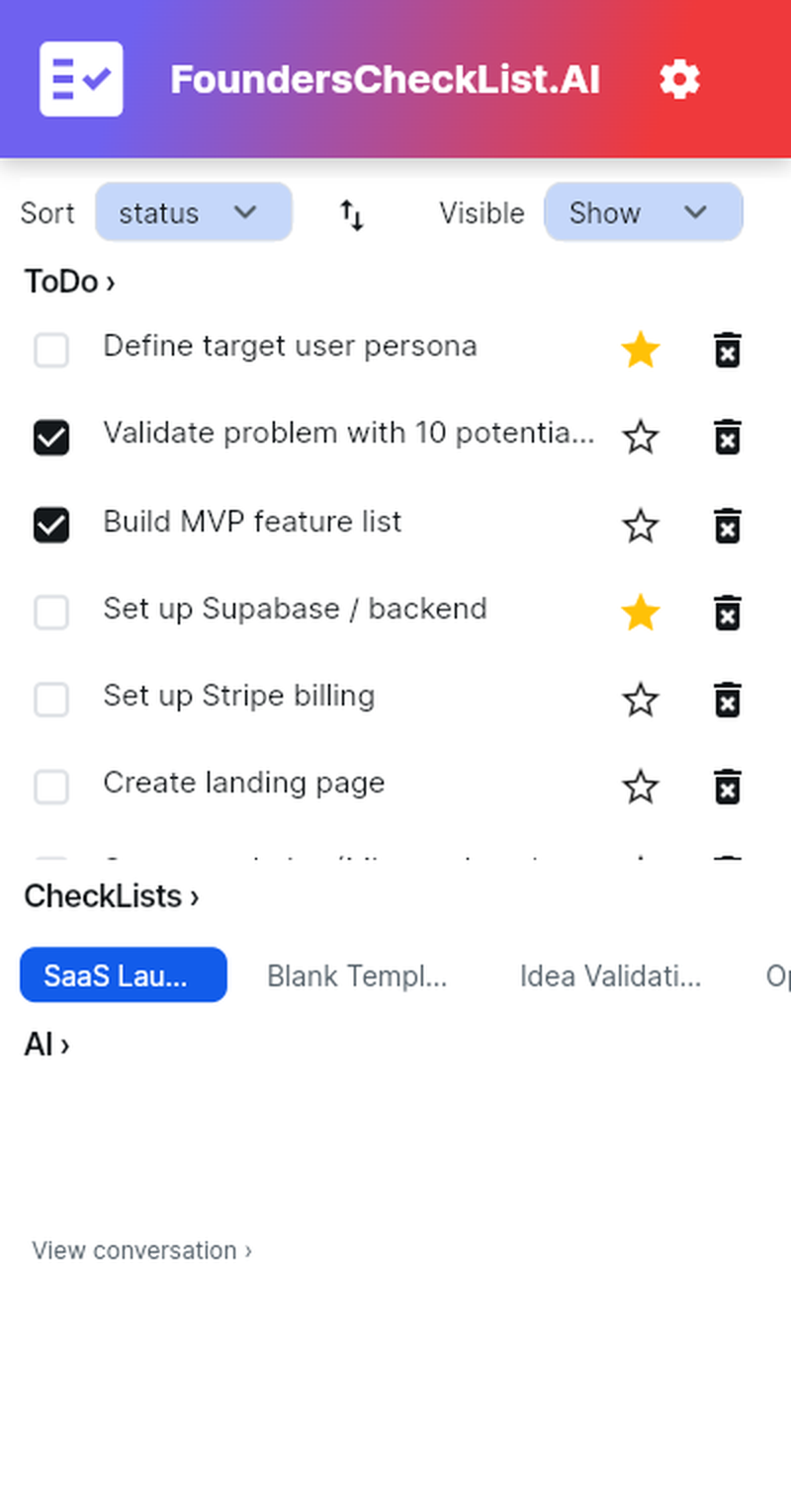
Inside the app, these definitions sit next to your real checklist tasks and guidance. Free to start.
See plans →