A one-page business plan that ships.
Why this matters
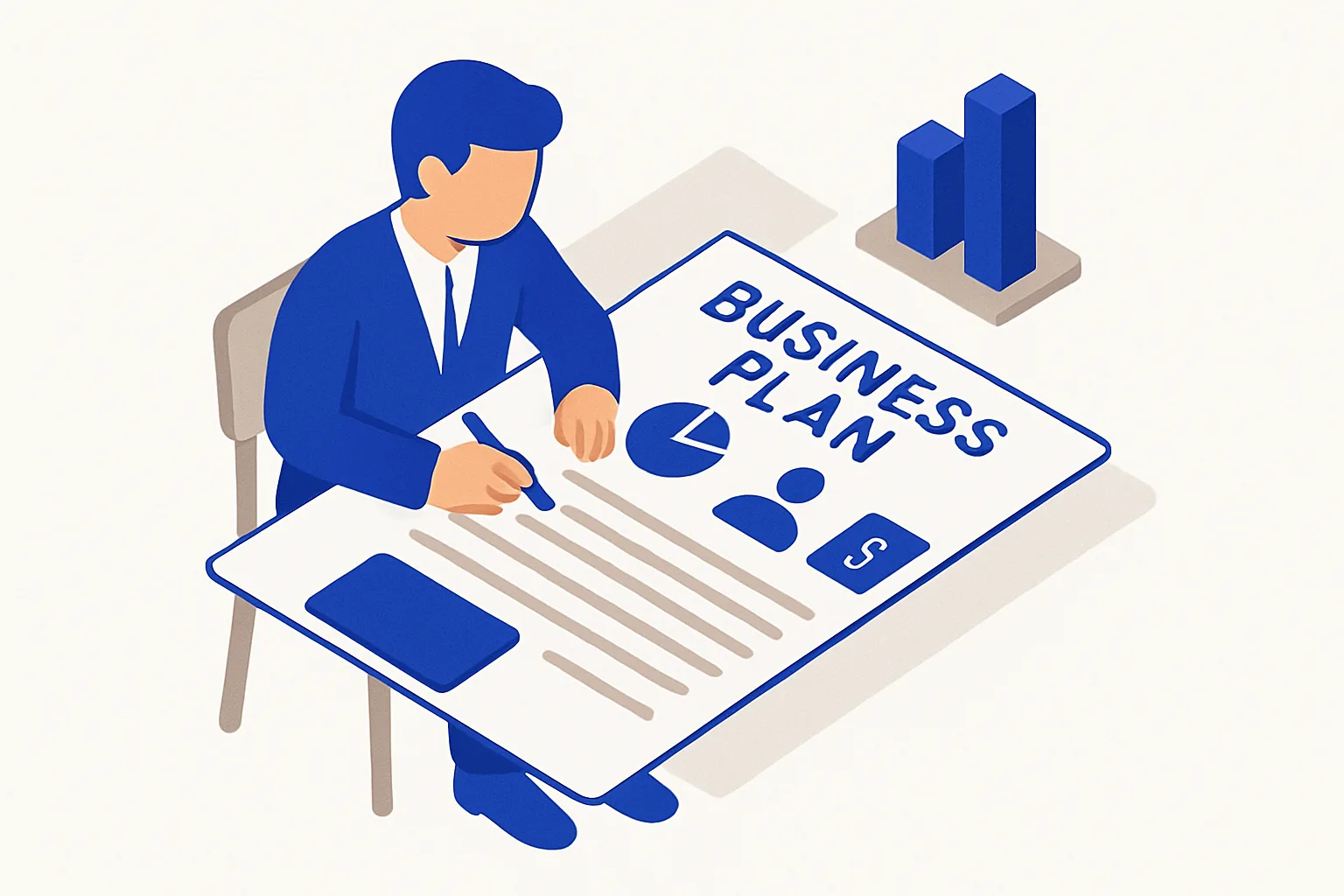
A plan you never finish is worse than no plan. Many first-time founders struggle to finish a long traditional plan. One page forces the decisions that actually matter: who pays you, what they pay for, and why they pick you over the option down the street. If you cannot fill one page, you are not ready to sign a lease or spend savings.
What "done" looks like
- One page states what you sell, who buys it, and your price
- You can name your top 3 competitors and your edge over each
- Startup costs and monthly break-even are written down as real numbers
- Someone outside the business can read it and repeat your model back
How to do it
- Answer three questions in plain words: what do you sell, who buys it, and why you instead of the alternative.
- List your prices and the cost behind each: materials, labor, your share of rent and overhead.
- Estimate monthly break-even: fixed costs divided by average profit per sale tells you how many sales a month keep you alive.
- Write startup costs as one number with a 20-30% buffer on top.
- Show it to two blunt people: one potential customer, one person who runs a business.
- Revisit it monthly and cross out what proved wrong, the plan is a tool, not a trophy.
Common mistakes
- Writing 30 pages of vision and zero numbers
- Copying a template's revenue projections instead of doing your own break-even math
- Treating the plan as final, real information from customers beats it every time
Real-world examples
- Ash Maurya's Lean Canvas is the best-known one-page format: a single sheet of nine boxes (problem, solution, key metrics, unique value proposition, unfair advantage, channels, customer segments, cost structure, revenue streams) that he introduced in his book Running Lean as a replacement for the traditional 50-page plan.
- It's an adaptation of Alex Osterwalder's Business Model Canvas, retooled for early-stage startups by swapping the "running a business" blocks for "starting a business" ones, the idea being you can sketch the whole model in well under an hour and see which assumptions could kill the company.
- Whichever template you use, the one-page constraint forces the same discipline: naming who you sell to, what you sell, and how money comes in. Feed it from your value proposition and your pricing tiers.
From a founder's point of view
A one-page plan is valuable precisely because it's too small to hide in. A long document lets you bury a shaky assumption under twenty pages of formatting; one page forces you to say plainly who pays, for what, and why they'd switch. Treat it as a living hypothesis you revise as you learn, not a document you write once to look official.
Rule of thumb
If a stranger can read your page in two minutes and tell you how the business makes money, it's done.