Why this matters
Pricing is positioning: it tells the market who the product is for and how seriously to take it. Founders habitually underprice, out of fear, not data, and then anchor their whole customer base low. You do not need perfect pricing to launch; you need a defensible starting point you intend to revise.
What "done" looks like
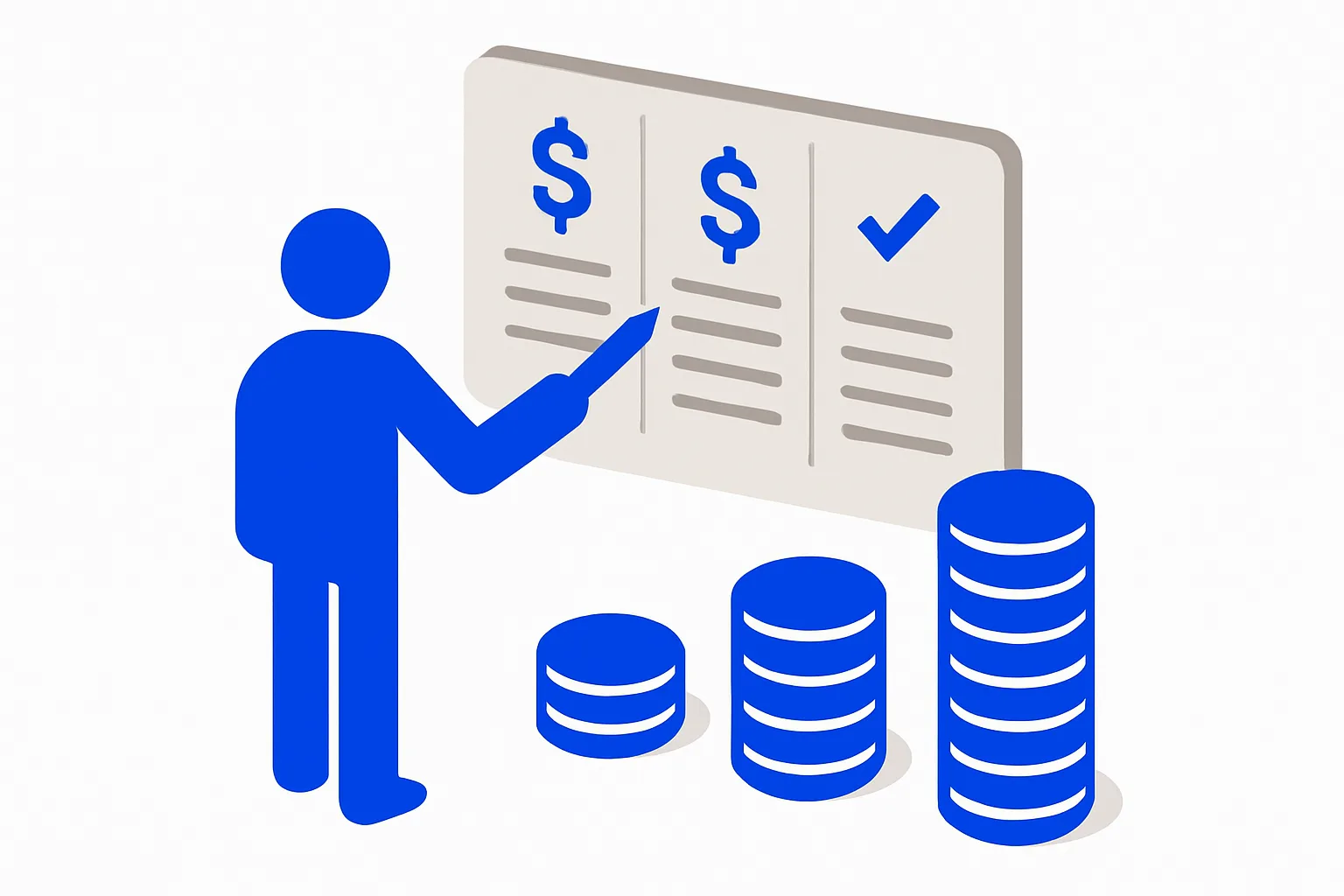
- 2 to 3 tiers written down with names, prices, and what each includes
- A value metric chosen (seats, projects, volume) that grows as the customer wins
- Annual and monthly prices set (annual discounted 15 to 20%)
- The pricing page drafted and understandable in ten seconds
How to do it
- Pick the value metric first. What do customers get more of as they get more value? Charge along that axis, not for arbitrary feature locks.
- Anchor on value, not cost. If you save a customer 5 hours a week, price against those hours, competitors, and the pain, not your server bill.
- Structure three tiers: entry (small users), core (most people, this is the one you design first), and a top tier that catches heavy use.
- Draw the feature lines so upgrading feels natural at the moment usage grows, not punitive.
- Write the page, then test it in sales conversations. Watch reactions; silence at a price is information too.
Common mistakes
- A free tier so generous nobody ever needs to pay
- Five confusing plans at launch, or "contact us" as the only price
- Never raising prices because early users anchored you
Real-world examples
- Behavioral economist Dan Ariely's well-known experiment used The Economist's three subscription options, online at $59, print-only at $125, and print-plus-online at $125. With all three shown, 84% chose the combined plan and nobody took print-only; remove the "useless" print-only decoy and preference flipped, with most people dropping to the cheap $59 tier. The middle option existed to make another look obviously worth it.
- "Good, better, best" is a common commercial pattern for the same reason: field-service tools like Housecall Pro encourage contractors to present three options so customers trade up rather than simply accepting or rejecting a single price.
- The practical takeaway is that tiers are a communication tool, not just a price list. They frame what "normal" looks like. Ground the numbers themselves in price your services.
From a founder's point of view
Most first-time founders under-think tiers, listing every feature and hoping the customer sorts it out. But the tiers themselves steer the decision: a well-placed middle option quietly makes the plan you actually want to sell feel like the sensible choice. The goal isn't to trick anyone, it's to package the offer so the right customer can see, fast, which plan is meant for them.
Rule of thumb
Occasional price resistance can be one signal that your pricing is in range, but it is not proof. If nobody ever says "that's expensive," consider whether you may be underpriced.