Why this matters
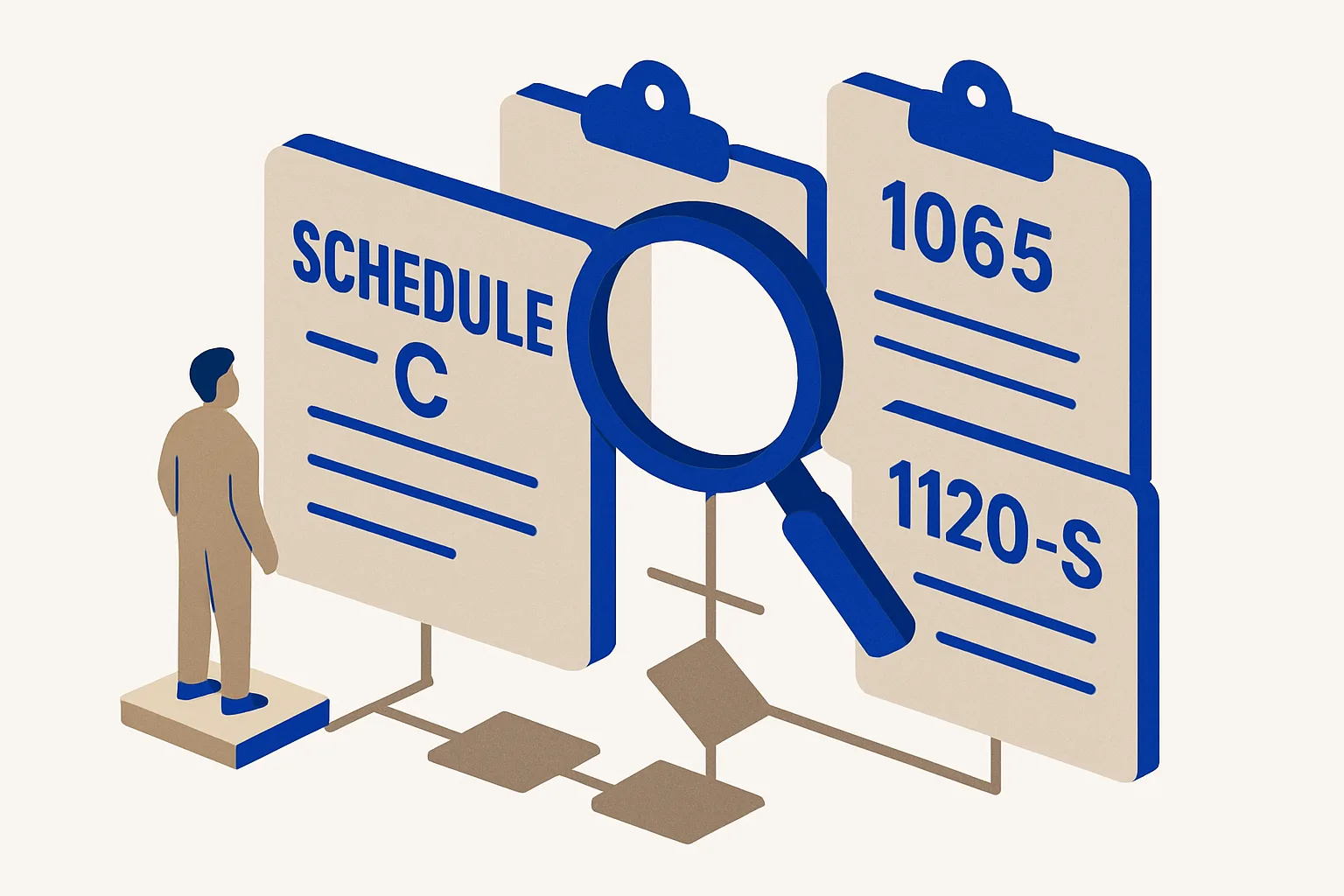
Which form your business files, Schedule C, Form 1065, or Form 1120-S, determines your deadline, your software, and whether you file one return or two. Partnerships and S corps that miss their earlier deadline rack up per-owner monthly penalties even when no tax is owed.
What "done" looks like
- You can name your entity type and the exact form it files
- You know your usual calendar-year deadline: March 15 for 1065/1120-S, April 15 for Schedule C filers, shifting to the next business day when necessary
- You know whether you file one return or a business return plus your personal 1040
- Any S corp election (Form 2553) has an IRS acceptance letter
How to do it
- Identify your legal entity. Sole proprietor or single-member LLC taxed as a disregarded entity → Schedule C on your 1040. Multi-member LLC or partnership taxed as a partnership → Form 1065. S corporation → Form 1120-S.
- Confirm any elections, an LLC that elected S corp status files 1120-S, not Schedule C; an LLC that elected C corp status files Form 1120; check your IRS acceptance letter.
- Mark the deadline. For calendar-year filers, Forms 1065 and 1120-S are usually due March 15, a month before personal returns; Schedule C rides on your 1040, usually due April 15. If a deadline falls on a weekend or holiday, it shifts to the next business day.
- Note the K-1 chain: 1065 and 1120-S returns issue K-1s your personal return needs, so the business return comes first.
Common mistakes
- Assuming "LLC" is a tax form. The IRS taxes an LLC as a sole prop, partnership, S corp, or C corp depending on members and elections
- Missing March 15 because you anchored on April 15
- Filing Schedule C after electing S corp status, leaving the 1120-S unfiled
Real-world examples
- The IRS late-filing penalty for Forms 1065 and 1120-S was $245 per partner or shareholder per month in 2025 (up to 12 months), and it applies even when the business owes no tax.
- TurboTax mirrors the split: Schedule C lives in its personal products; 1065 and 1120-S require the separate TurboTax Business product.
From a founder's point of view
Entity choice happens once; the filing consequences repeat every year. Knowing your form is the difference between a calm March and an April discovery that a return was due a month ago, meter running per owner.
Rule of thumb
Say it in one sentence, "I'm an X, I file form Y, due on date Z." If you can't, resolve that before touching any tax software.